Blogs
Simple EDV & Two Way ANOVA Applications in Core Sample Data: Case Study from Volve Open Datasets
27 April 2021
By: Mordekhai
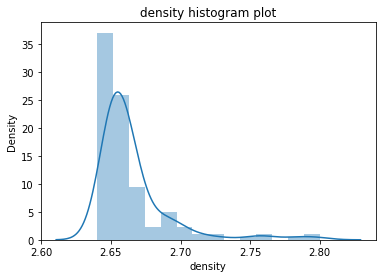 ANOVA (Analysis of Variance) is a statistical test that determines whether a parameter is significant to other parameters. ANOVA can be divided into two types: one-way ANOVA and two-way ANOVA. One-way ANOVA only tests the significance of one parameter, while two-way ANOVA can test the significance of more than 2 parameters. This article will focus on how to perform an exploratory data visualization followed by two-way ANOVA.
The data used in this article are from Volve Open Datasets, which will be used as a subset by taking only the density, permeability, and core sample parameters.
Read More...Creating Presentable Data Visualization with Altair: Case Study using Geothermal Heatflow Data
14 January 2021
By: Mordekhai
Altair is a python library that mainly focuses on declarative visualization. This library has a syntax that is concise enough to perform various visualizations. One of the significant difference between Altair and other visualization libraries is that Altair has one-liner coding properties, which does not require many coding lines to display various visualizations.
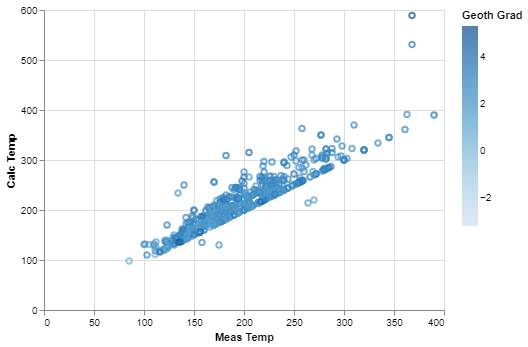
In this article, we will not elaborate on all the uses of Altair. Rather we will explore some interesting functionality that is suitable to be applied with our dataset. For the best visualization experience, please use Jupyter Lab or Jupyter Notebook IDE. Altair Installation can be done with pip install altair.
The data used in this article are part of the South East geothermal heat flow compilation data from Royal Holloway South East Asia Research Group.
Read More...Linear vs Non-Linear Dimensionality Reduction in Well Log Data
30 December 2020
By: Mordekhai
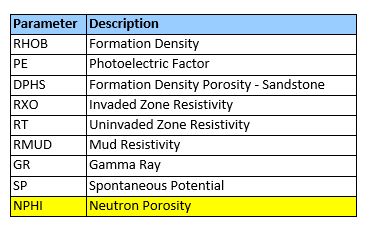
Dimensionality reduction is a common step for data processing. This process is useful for feature engineering or data visualization. Too many features in a dataset can complicate data visualization and analysis afterwards. Therefore, dimensionality reduction is needed to overcome this problem.
Dimensionality reduction does not automatically reduce the existing features. This method will first summarize all features in a dataset into several components according to the algorithm we use. There are two different methods in dimensionality reduction: Linear (Principal Component Analysis) or Non-Linear (Manifold Learning). In this article we will implement and compare these two methods using well log data.
Read More...Hypothesis Testing for Determining Facies Data Distribution: Sand vs Shale Case Study based on Well Log Data
26 November 2020
By: Mordekhai
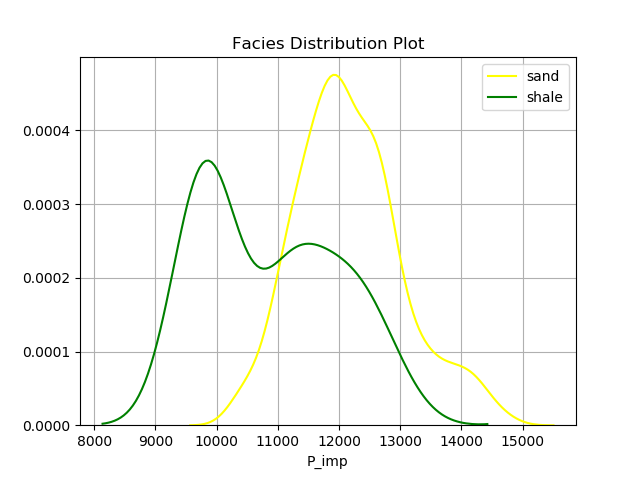 Essentially, hypothesis testing is a statistical method that performs the test of an assumption, so that the results can be declared accepted or rejected. Hypothesis testing is part of inferential statistics.
Hypothesis can be divided into two parts:
-
Null hypothesis (H0): Null hypothesis is a statement that will be verified.
-
Alternative hypothesis (H1): Alternative hypothesis is an alternative statement when statement (H0) is rejected.
In this article, we use facies data which is derived from Well Log Data. Hypothesis testing is done to determine whether the facies data (Sand & Shale) comes from the same population (can be concluded to have the same distribution) or not.
Read More...Python for Geoscientists: Beyond the machine learning
28 April 2020
By: Izzul Qudsi
This day, almost all of our analysis is able to be processed by some particular software. Any kind of dataset, seismic, well log, and the other, any phase of analysis, pre-processing, processing, interpretation are covered. Unfortunately, many of us are not lucky enough to have access to this software or sometimes, the software owned by our organization does not cover the alternative method that we would like to try on the data. Referring to my past experience, I would like to encourage my fellow geoscientists to unleash the ability of this programming language beyond the SKLEARN module. There are plenty of Python’s modules that could be useful for us to do some simple geological and geophysical analysis to the advanced one. We can do from a simple rock physics cross plot to the petrophysical analysis / seismic inversion, or from reduce to pole filter on aeromagnetic data to subsurface magnetic body modeling.