Publications
Application of First-Arrival Travel Time Tomography: Velocity Modeling for Time-to-Depth Conversion
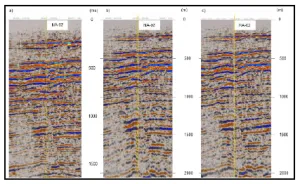
Seismic data has a broad range of lateral area recorded in time domain. Generally the seismic interpretation is done in time domain. Doing stratigraphic interpretation in time domain is usually sufficient. On the other hand, doing structure interpretation in time domain has a higher risk of pitfall. Time-to-depth conversion is one way to eliminate structure ambiguity in time domain and verify the structure. In this study, authors used the first-arrival travel time tomography method in modeling velocity for time-to-depth conversion. This method used the first-arrival travel time of seismic data. The travel time data, combined with the initial velocity model, became the input for travel time tomography. Tomographic process consisted of two processes: modeling and inversion of travel time. Modeling the travel time itself included travel time calculation and raytracing. The travel time inversion produced velocity model. The velocity model was then used in time-to-depth conversion. Then the result of the conversion was validated with VSP data. Validation of the velocity model showed good results. Hence, this method can be used in building velocity model which does not have data of time versus depth, such as checkshot or VSP data, for time-to-depth conversion.
Read More...Dip-steered Seismic Attributes and Petrophysics Analysis for Volcanic Reservoir Characterisation: A Case Study of Kora Volcano, New Zealand
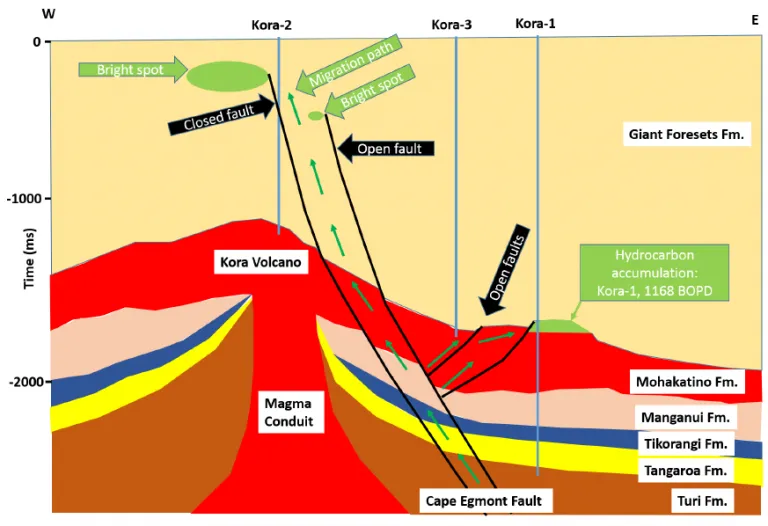
Kora Volcano is a submarine stratovolcano that is located in Northern Taranaki Basin, New Zealand. Volcanism associated with the formation of Kora Volcano is suggested as the main factors that control the hydrocarbon prospect in this area. This study aimed on characterising volcanic reservoirs that structurally and stratigraphically complex. 3D seismic cube and well data were used to characterise the reservoir by performing seismic attributes and petrophysics analysis.
Seismic attributes were generated from seismic data and accounted the local dipping and azimuth of the reflectors, known as dip-steering. Significant enhancement after the application of dip-steering in generating seismic attributes to delineate the complex structural framework suggested that the method is extremely important in modern seismic attributes analysis. Also, seismic interpretation accuracy was improved significantly by using dip-steered attributes as the guidance to define the complex structures. Last, combined with petrophysics analysis, these advanced seismic attributes were used to regulate the reservoir properties distribution in seismic data.
Geologically plausible model was produced that accounted not only petrophysics parameters, but also the influence of the structures that could be an alternative way for reservoir characterisation in highly sparse well data.
Read More...